
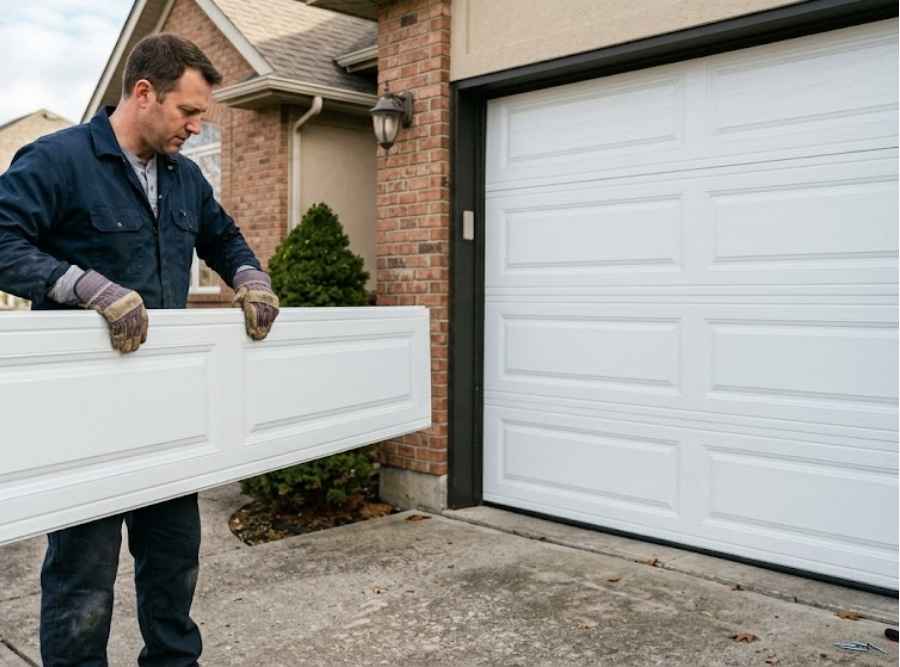
Can You Replace a Garage Door Panel Yourself?
For some doors, yes, individual panel kits exist and cosmetic panel swaps are possible without professional help, as long as the frame and track around the damaged panel are undamaged. But a garage door is a balanced system under spring tension, and a panel that’s even slightly heavier or lighter than the original can throw that balance off. Blue Steel Garage Door Services serves homeowners across Pasco and Hillsborough Counties who are weighing DIY panel replacement against a professional swap, and this guide covers how to tell which situation applies.
When Is DIY Panel Replacement Actually Realistic?
Panel replacement is most realistic on sectional doors where the manufacturer still sells a matching replacement panel, the surrounding frame and track show no structural damage, and the homeowner is comfortable working around spring tension without touching it directly. If the damage is limited to a single panel — a dent, a crack, weather damage rather than something structural, and a genuinely matching panel is available, it’s a reasonable project for someone comfortable with basic tools and a weekend.
What Are the Real Risks of a DIY Panel Swap?
A garage door’s springs are calibrated to the door’s total weight, and swapping in a panel that’s even slightly heavier or lighter than the original throws that calibration off. This happens more often than homeowners expect, since insulation specs and materials can change between production runs even on the same model line. An unbalanced door forces the opener to work harder on every single cycle, which accelerates wear on the motor and gears and can cause the door to close unevenly or reverse unexpectedly partway through its cycle.
This is a case where the symptom that shows up first — a panel that looks fine after installation isn’t necessarily the whole story. A door can look correctly repaired and still be operating out of balance in a way that shortens the life of the opener and other components.
How Do You Find a Matching Panel, and What Does It Actually Cost?
The biggest practical obstacle to DIY panel replacement usually isn’t the installation itself, it’s finding the panel. Discontinued models and color-matching against a sun-faded existing door are common problems, and a panel that’s a close-but-not-exact match will be visible from the driveway. Requesting a physical sample or seeing the panel in person before ordering is the most reliable way to avoid a visible mismatch.
On cost, a DIY panel kit typically runs in the range of $150 to $400 depending on size and material, while professional replacement — which includes labor and a post-installation balance check generally runs higher, often $300 to $800 or more per panel. The gap reflects the balance verification and correct-fit sourcing bundled into professional service, not just the physical part.
For homeowners who’d rather not gamble on a panel match or risk throwing the door’s balance off, Blue Steel Garage Door Services handles panel sourcing and replacement across Pasco and Hillsborough Counties with a balance check included. More detail on that process is on the Garage Door Replacement page.
Frequently Asked Questions About DIY Garage Door Panel Replacement
How much does a DIY panel kit cost compared to professional replacement?
DIY panel kits generally run $150 to $400 for parts, while professional replacement which includes labor and a balance check after installation typically runs $300 to $800 or more depending on the door and panel type. These are general industry ranges, not confirmed Blue Steel pricing.
Will a DIY panel replacement look mismatched against the rest of the door?
It can, especially on older doors. Sun exposure fades panels unevenly over years, so even a panel from the same manufacturer and color code may look noticeably different from panels that have weathered outdoors for a long time. Requesting a sample swatch or seeing the panel in person before committing is the best way to check for a mismatch in advance.
Can a mismatched panel weight actually damage the opener?
Yes, over time. A panel that’s heavier or lighter than the original throws off the spring balance calibrated for the door’s original weight, which forces the opener to work harder on every cycle. That added strain accelerates wear on the opener’s motor and gears rather than causing immediate failure.
